
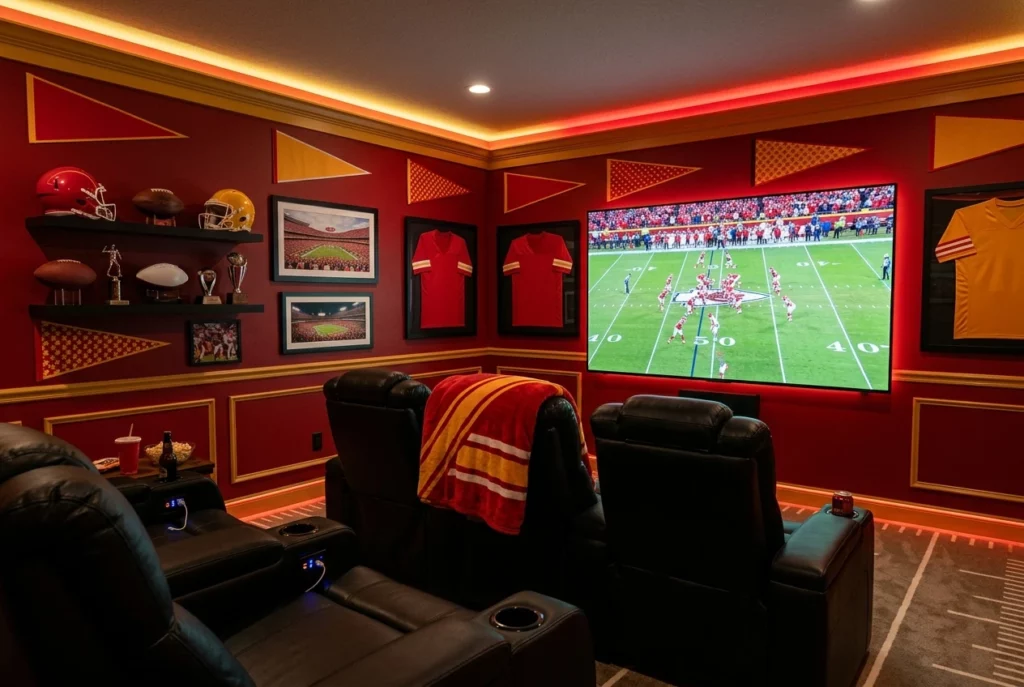
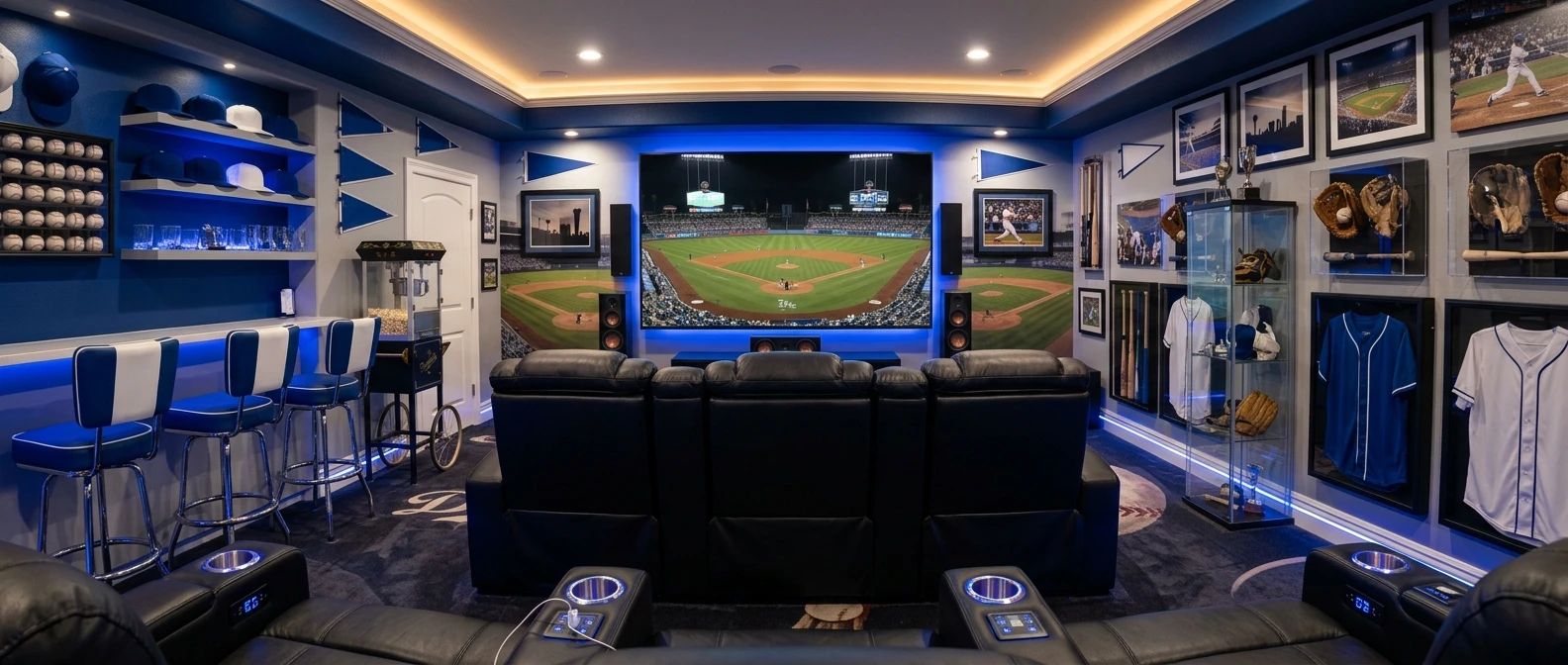
A hand-me-down couch tells your buddies this room is an afterthought. The right seating tells them you built this space on purpose. Home theater seating for mancaves has become its own category for a reason: these rooms take a beating during football season that a living room sofa was never built to handle, and the seats need to work for solo Sunday mornings and fifteen-person playoff parties with the same ease.
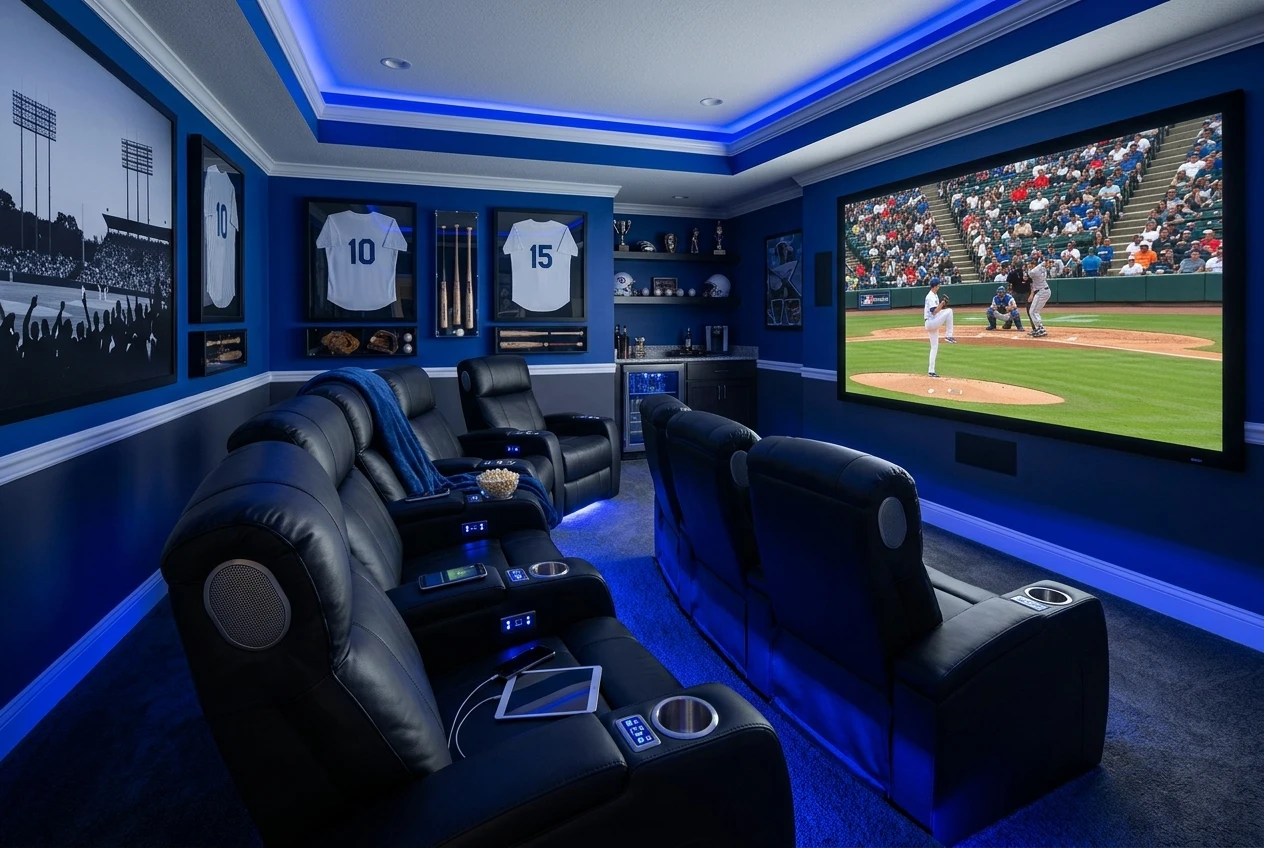
This guide focuses on what matters when you’re buying seating for a dedicated sports space: spill resistance versus comfort, how many bodies you really need to fit, and matching your team’s colors without turning the room into a costume.
Why Theater Seating Beats a Regular Couch for a Mancave
A standard sofa is built for sitting upright and having a conversation. Theater seating is built for watching something for three hours straight, which is a different job with different requirements.
Individual recliner seats give each person their own armrests, their own recline angle, and their own cup holder instead of one shared cushion and a fight over the remote. For a room where guys are going to be parked for an entire game, that separation matters more than it sounds like it would.
Theater seating also tends to sit lower and angle slightly toward the screen, which is exactly the setup you want for a big-screen TV or projector. A couch facing a TV at a normal living room height works fine for background noise. It doesn’t work as well when the screen is the whole point of the room.
There’s also the matter of durability. Furniture marketed for media rooms is generally built with denser foam and sturdier frames than a mid-range living room couch, because it’s expected to get more hours of actual use. A couch gets sat on in the evening. Theater seating in a sports den gets sat on for six hours straight on a Saturday in college football season, then again on Sunday for the NFL slate.
Leather vs Fabric: Which Holds Up to Game Day Spills and Snacks
Three years from now, this one decision determines whether your seating still looks sharp or starts looking like a frat house relic.
Leather (and leather match/faux leather) wipes clean. Beer, wing sauce, queso, whatever gets dropped during a close fourth quarter, comes off a leather or faux leather surface with a damp cloth in a way it never will with fabric. For a room where food and drink are constantly in play, this alone makes leather the default recommendation.
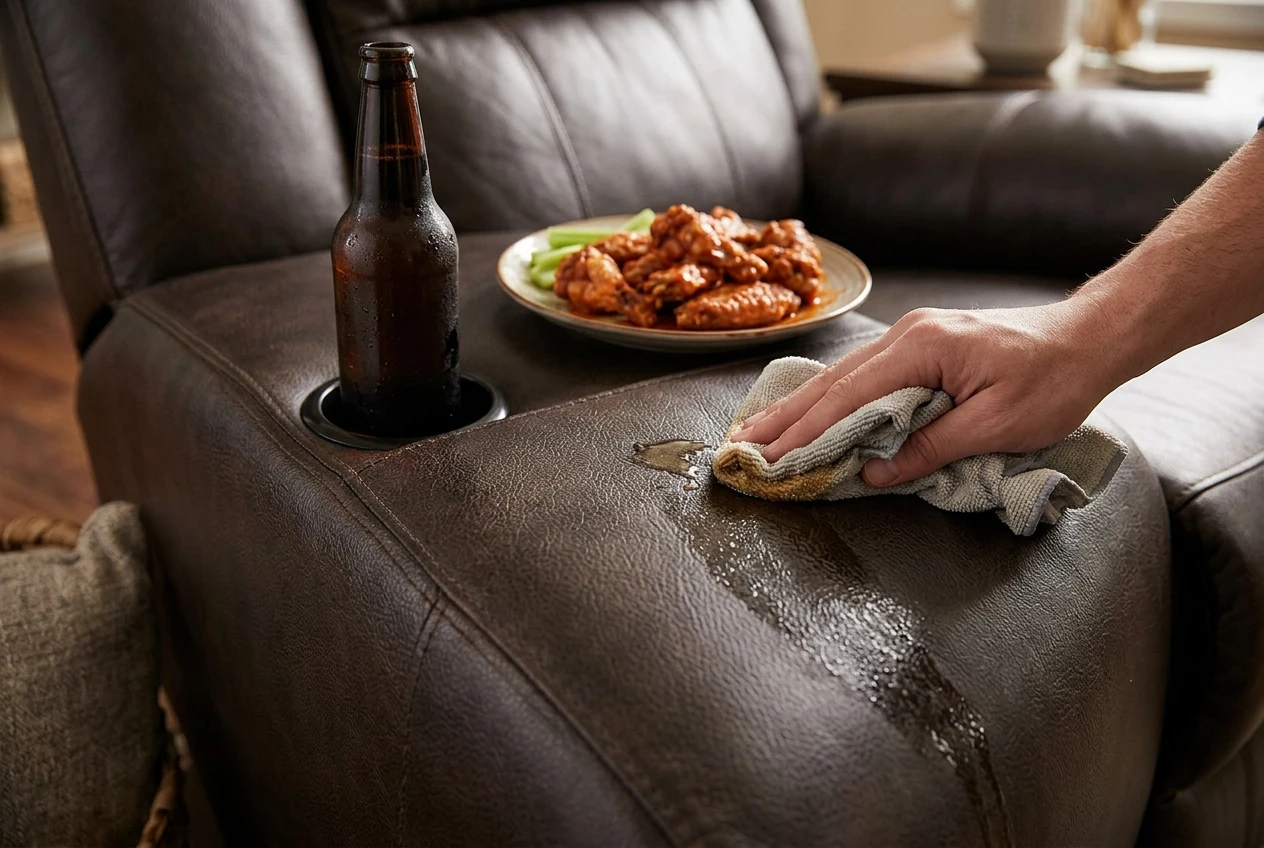
Genuine top-grain leather is the most durable and ages well, but it also carries the highest price tag. Leather match (a leather front with vinyl or fabric sides and back) and bonded leather are more budget-friendly and still wipe clean, though they don’t hold up quite as long under heavy use. For a mancave that sees regular traffic, leather match is usually the sweet spot between cost and cleanability.
Fabric feels more comfortable to some guys, especially in colder climates where leather can feel stiff or chilly. It also tends to come in a wider range of colors, which matters if you’re trying to match team colors exactly. The tradeoff is absorption. A spilled drink on fabric soaks in before anyone can grab a towel, and certain fabrics stain permanently from hot sauce or red wine.
If fabric is the look you want, look for seating listed as stain-resistant or treated with a protective coating, and keep a fabric cleaner on hand specifically for upholstery. Microfiber is a reasonable middle ground: it has some of the softness of fabric with better spill resistance than untreated cotton or polyester blends.
For a room that’s genuinely going to host watch parties with food and drink in constant motion, leather or leather match is the safer bet. Save fabric for a room that doubles as a quieter lounge space.
Recliner Features Worth Paying For (and Which Are Just Marketing)
Recliner seating comes loaded with feature lists, and not all of them earn their keep. Some are worth the extra money. Others mostly pad a spec sheet.
Worth paying for:
- Power recline. A button instead of a manual lever sounds minor until you’re holding a plate of nachos and a drink. Power recline also tends to come with a smoother, quieter motion than manual mechanisms.
- Power headrest and lumbar adjustment. These let each person dial in their own position, which matters more in a room where seats get used for hours at a stretch.
- USB charging ports built into the console or armrest. Phones die during games. A built-in port means nobody’s hunting for an outlet during a timeout.
- Memory foam or high-density foam cushions. Cheaper foam breaks down and loses its shape within a year or two of regular use. Higher-density foam costs more up front and holds its shape much longer, which matters in a room that gets daily use during the season.
Mostly marketing:
- Built-in massage functions. These sound great in a showroom and get used twice before being forgotten. Unless massage is something you specifically want, it’s rarely worth the price jump.
- Excessive stitching or “designer” detailing. Decorative stitching patterns don’t affect comfort or durability and often just add cost.
- Oversized consoles with built-in coolers. A cooler console can be genuinely useful, but many versions on the market are small enough that they hold a couple of cans and not much else. Check actual capacity before assuming it solves your drink storage problem.
Comfort, durability, and convenience during a game are worth paying extra for. A longer feature list that doesn’t touch any of those three is paying for a brochure line, not a better seat.
Row Seating vs Sectional Layouts for Different Room Shapes
The shape of your room should decide this more than personal preference, because the wrong layout in the wrong room creates sightline problems and wasted space.
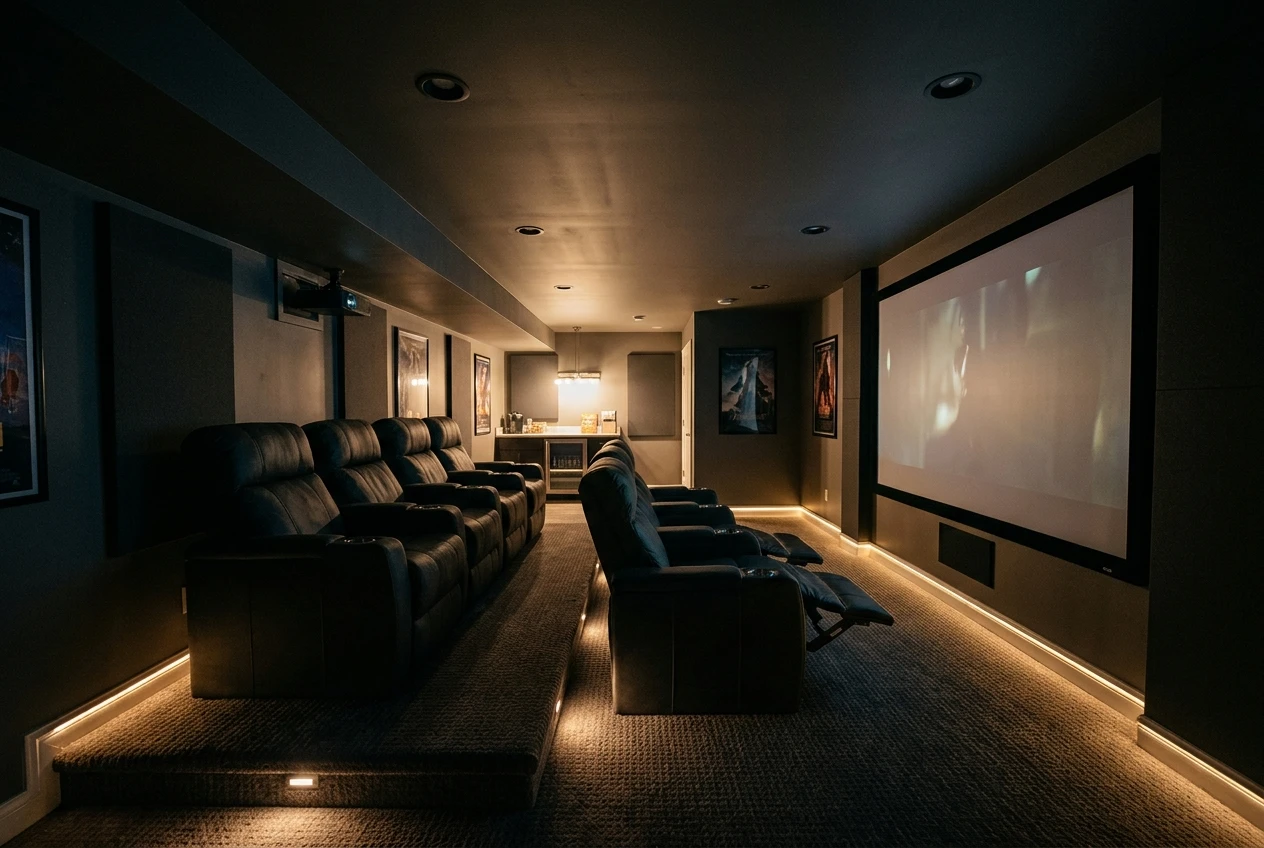
Row seating (recliners lined up facing the screen, sometimes on a riser for the back row) works best in long, narrow rooms, the kind you often get when converting a basement or a bonus room above a garage. It mimics an actual home theater and gives every seat a clean, direct view of the screen. Row seating is also the better choice if you want true individual recliners with armrests and consoles between every seat.
The downside is that row seating is less social. It’s built for watching, not for chatting during commercial breaks, and it doesn’t flex well if your crowd size varies a lot from week to week.
Sectional seating (an L-shaped or U-shaped arrangement, sometimes with recliner ends) works better in square or wide rooms, and it’s more forgiving if the room doubles as a general hangout space rather than a dedicated theater. Sectionals also make it easier for a group to talk to each other, which matters if your sports den hosts people who aren’t all glued to the screen the entire time.
A hybrid approach is common and often the smartest move: a row of two or three recliners for the prime viewing seats, with a sectional or additional seating along the side walls for overflow during bigger watch parties. This gives you dedicated theater-style seats for regular use and extra capacity without buying a full second row of recliners that sit empty most of the time.
Before committing to a layout, measure your room and map out sightlines to the screen from every seat you’re planning. A recliner angled even slightly off-center from a large screen becomes an annoying seat fast, and it’s a cheap problem to avoid with a tape measure before you buy.
Matching Seating to Your Team Colors Without It Looking Tacky
Team colors in a sports den work best as an accent, not the entire color scheme. A room done head to toe in one team’s exact colors can start to look more like a retail display than a space someone actually lives in.
A few approaches that hold up better over time:
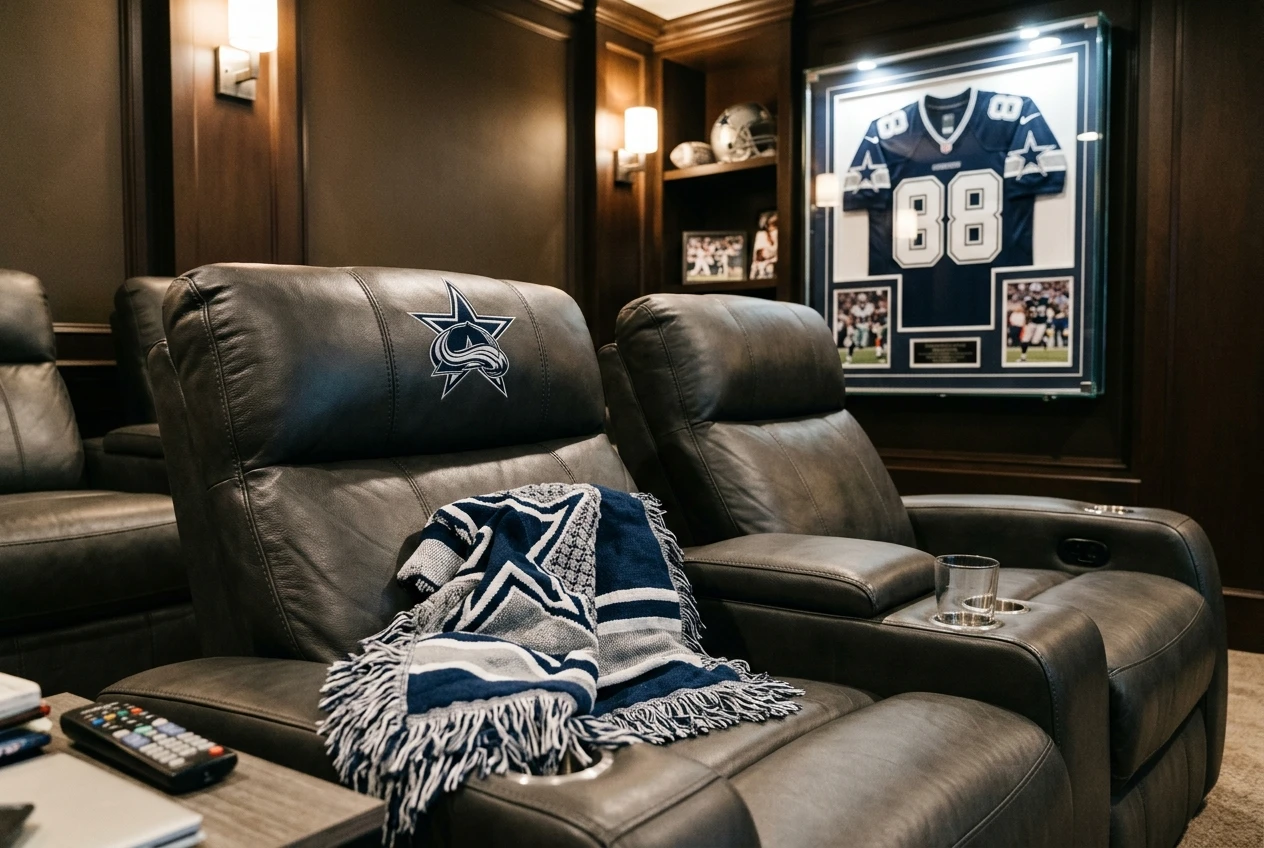
- Neutral seating, team-colored accents. Choose leather or fabric in black, brown, gray, or navy, then bring in team colors through throw pillows, a team blanket draped over an armrest, or stitched team logos on the headrest. This way the big-ticket furniture item stays flexible if you ever change allegiances, move, or just want to refresh the look.
- One bold piece, not the whole set. If you want actual team-colored upholstery, consider it for one or two accent chairs rather than the entire row. A full room of bright team-colored recliners can overwhelm a space, especially under bright game-day lighting.
- Match the undertone, not the exact shade. If your team’s colors are navy and gold, for example, navy leather seating reads as intentional and sharp. Bright yellow leather recliners next to a navy-and-gold jersey display case can start to clash rather than complement.
- Let the room’s other elements carry the color. Jerseys, pennants, and memorabilia displays are naturally suited to showing off team colors boldly because they’re meant to be decorative. Seating is functional furniture you’ll be using for years, so it benefits from restraint. If you’re building out a display case for signed items or vintage pieces, that’s actually a better home for bold team colors than the recliners themselves.
A sports den reads as a serious fan’s space when the furniture stays quiet, and the memorabilia does the talking.
Cup Holders, Storage, and Built-In Tech That Actually Get Used
Some add-on features earn their keep every single game. Others get used once and ignored.
Cup holders are non-negotiable, and more than you think you need is the right number. A recliner with one cup holder per seat sounds sufficient until someone’s got a beer, a water, and a phone they want to have within reach. Dual cup holders per seat, or a cup holder plus a small tray table built into the console, solves this without anyone balancing a drink on the armrest.
Storage consoles between seats are genuinely useful for remotes, controllers, and the inevitable pile of takeout napkins that accumulates during a game. Look for consoles with a flip-up lid rather than just an open tray, since an open tray tends to collect clutter in plain view.
Built-in tech is where it’s worth being selective. USB charging ports are used constantly and worth paying for. Built-in Bluetooth speakers in the headrest sound appealing but often get skipped once the room already has a real sound system, which most dedicated sports dens eventually do. If you’re investing in proper audio for the room, a recliner’s built-in speaker is redundant rather than additive.
Heating elements in the seat are a nice-to-have in cold climates and a non-issue everywhere else. Cooling features in cushions are rarer and mostly unnecessary unless the room runs consistently warm.
A drink within reach, a charged phone, and a place for the remote solve the three problems that actually come up during a three-hour game. Anything beyond that is worth checking against whether the room already has it covered somewhere else.
How Many Seats You Really Need Based on Room Size and Crowd
This is where a lot of guys either overbuy or underbuy, and both mistakes get expensive.
Start with your room’s actual square footage and work backward. As a rough guide:
- Small room (roughly 150 to 200 square feet): Two to three recliner seats is usually the practical ceiling once you account for the TV distance, walking space, and any bar or display furniture also in the room.
- Medium room (roughly 200 to 300 square feet): Four to six seats, often arranged as a row of recliners with a sectional or additional chairs along the side.
- Large room (300+ square feet, common in converted garages): Six or more seats, frequently split between a primary row of recliners and secondary seating for overflow.
The bigger question is honest sizing for your actual crowd, not your aspirational one. If your regular watch party is three or four guys and the big games bring in eight to ten, it rarely makes sense to buy ten recliners that sit empty most Sundays. A better approach is to buy quality recliners for your regular crowd size and plan for overflow seating, bar stools, a sectional, and folding chairs kept in a closet for the handful of bigger game days per season.
It’s also worth leaving walking space and sightline room as a priority over cramming in one more seat. A room with five recliners jammed shoulder to shoulder with no room to walk to the bar or bathroom gets uncomfortable fast, even on a day when all five seats are needed.
Budget Tiers: What Changes as You Spend More
Theater seating spans a wide price range, and what you get at each tier is fairly predictable.
Entry level. At this tier, expect manual recline, faux leather or basic fabric upholstery, simpler foam that will show wear faster, and basic cup holders without much else built in. This tier is a reasonable starting point if you’re furnishing a room on a budget and plan to upgrade later, or if the room gets lighter use.
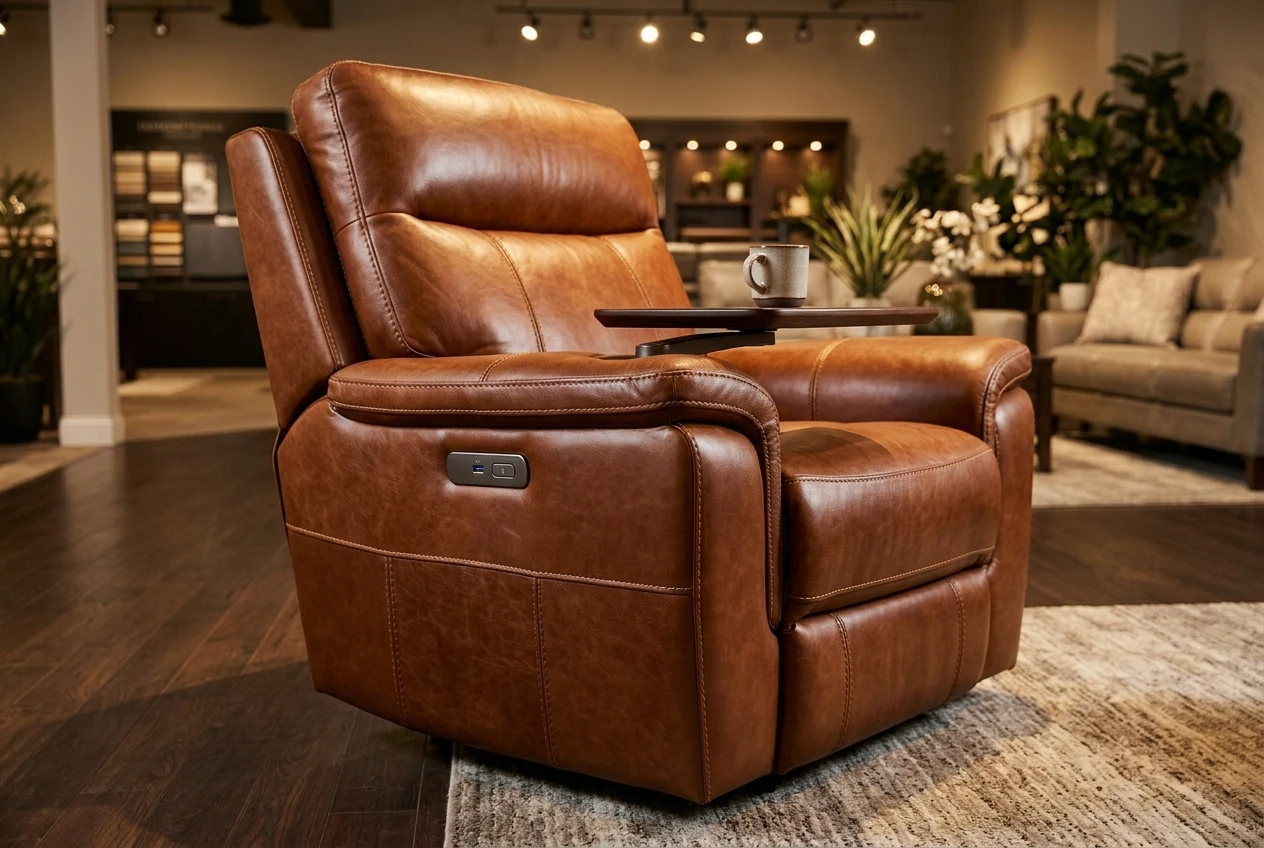
Mid-range. This is where power recline becomes standard, foam quality improves noticeably, and USB charging starts showing up as a built-in feature rather than an add-on. Leather match upholstery is common at this tier, giving you spill resistance without the full cost of top-grain leather. For most guys building a serious but not extravagant sports den, this tier delivers the best balance of cost and features that actually get used.
High end. At the top tier, you’re paying for genuine top-grain leather, power headrest and lumbar adjustment on top of power recline, denser and longer-lasting foam, and sturdier frame construction rated for years of heavy daily use. This tier also tends to offer more customization, different base colors, stitching options, and configurations for row versus sectional setups built to order.
The jump from entry to mid-range tends to deliver the most noticeable improvement in day-to-day comfort and durability. The jump from mid-range to high end delivers longevity and small comfort refinements, and it’s worth asking honestly how many hours a day the seating will actually be used before paying for the top tier across every seat.
A practical approach many guys take is buying high-end for the one or two “prime” seats, the ones used almost daily, and mid-range for the rest of the row or the overflow sectional. That puts the money where the wear happens most.
Seating is one of the biggest investments in a sports den, but it’s only one piece of a room that works as a whole. For a full breakdown of how seating fits alongside lighting, the bar setup, the screen, and everything else that turns a spare room into a real sports den, check out the ultimate mancave checklist for more than 30 ideas to round out the space.