

A speaker system can cost thousands of dollars and still sound bad in a spare room or garage. The speakers are only half the system. The other half is the room, and a bare room with drywall, concrete, a big TV, and a hard floor sends sound bouncing around until commentary turns to mush and bass booms in one corner of the couch.
This guide covers acoustic treatment for a man cave in plain terms, using pieces that look like decor, so you can fix the sound without turning the place into a recording booth.
Why a $10,000 Speaker System Can Still Sound Bad in Your Man Cave
Sound leaves a speaker and keeps traveling until something absorbs it. In a typical man cave, almost nothing does. Drywall, a concrete floor, a glass-fronted memorabilia case, and a giant TV screen all reflect sound into the room.
Those reflections arrive at your ears a split second after the direct sound from the speaker. The result is a smeared sound. A play-by-play announcer’s words blur together, crowd noise washes over everything, and the thud of a kickoff turns into a long drone.
Bass causes a separate problem. Low frequencies build up in corners and along walls, so one seat sounds boomy, and the seat beside it sounds thin. Moving a speaker an inch will not fix that. The room has to be treated.
Garages and basements are the worst cases. Concrete floors, bare block or drywall, low ceilings and a big overhead door give you plenty of hard surface and nowhere for sound to go.
Clap Test: How to Hear What Your Room Is Doing Wrong
You do not need any equipment to find the problems. Start with three quick checks.
The clap test. Stand in the middle of the room and clap once, sharply. Listen to what happens after the clap. A short, dry pop means the room is fairly well behaved. A buzzing, fluttery ring, almost like a metallic zing, is called flutter echo, and it means two hard, parallel surfaces are bouncing sound back and forth. A long tail that hangs in the air means the room has too much reflection overall.
The commentary test. Put on a game broadcast at the volume you actually watch at and sit in your main seat. Can you understand every word from the announcers without straining? If you catch yourself turning up the volume to make speech clear, reflections are blurring it.
The bass walk. Play something with steady, deep bass, such as a bass-heavy song or a stadium-sized highlight reel. Walk slowly around the room and through each seat. Note where the bass swells, where it nearly disappears, and which corners sound loudest. Those spots tell you where bass traps belong.
Write your findings down. After each round of treatment, repeat the same three checks so you can hear whether the change did anything.
Absorb, Diffuse, Trap: The Three Jobs of Acoustic Treatment
Studio people use a lot of jargon for this. In a man cave, there are only three jobs.
Absorb. Soft, porous materials soak up sound instead of bouncing it back. Panels filled with mineral wool or rigid fiberglass, thick rugs and heavy drapes all do this. Absorption cuts echo and makes speech clearer. It is the job you will do most.
Diffuse. Uneven surfaces scatter sound in many directions instead of sending it straight back. A bookshelf filled with books of different sizes does this well. Diffusion keeps a room from sounding dead, because it spreads sound around without removing it.
Trap. Bass needs thick material, placed in corners, to be absorbed. Bass traps are just extra-thick absorbers. The thicker the panel, the lower the frequencies it handles, which is why the thin foam sold in sheets does almost nothing for boomy bass.
Most rooms need a lot of absorbing, a little diffusing, and a few bass traps. The rest of this guide puts those three jobs where they matter most.
First Reflection Points: Where Panels Do the Most Good
You do not need to cover every wall. A handful of well-placed panels does more than a room full of random ones. The spots that matter most are the first reflection points: places on the walls and ceiling where sound from your speakers bounces once and then reaches your ears.
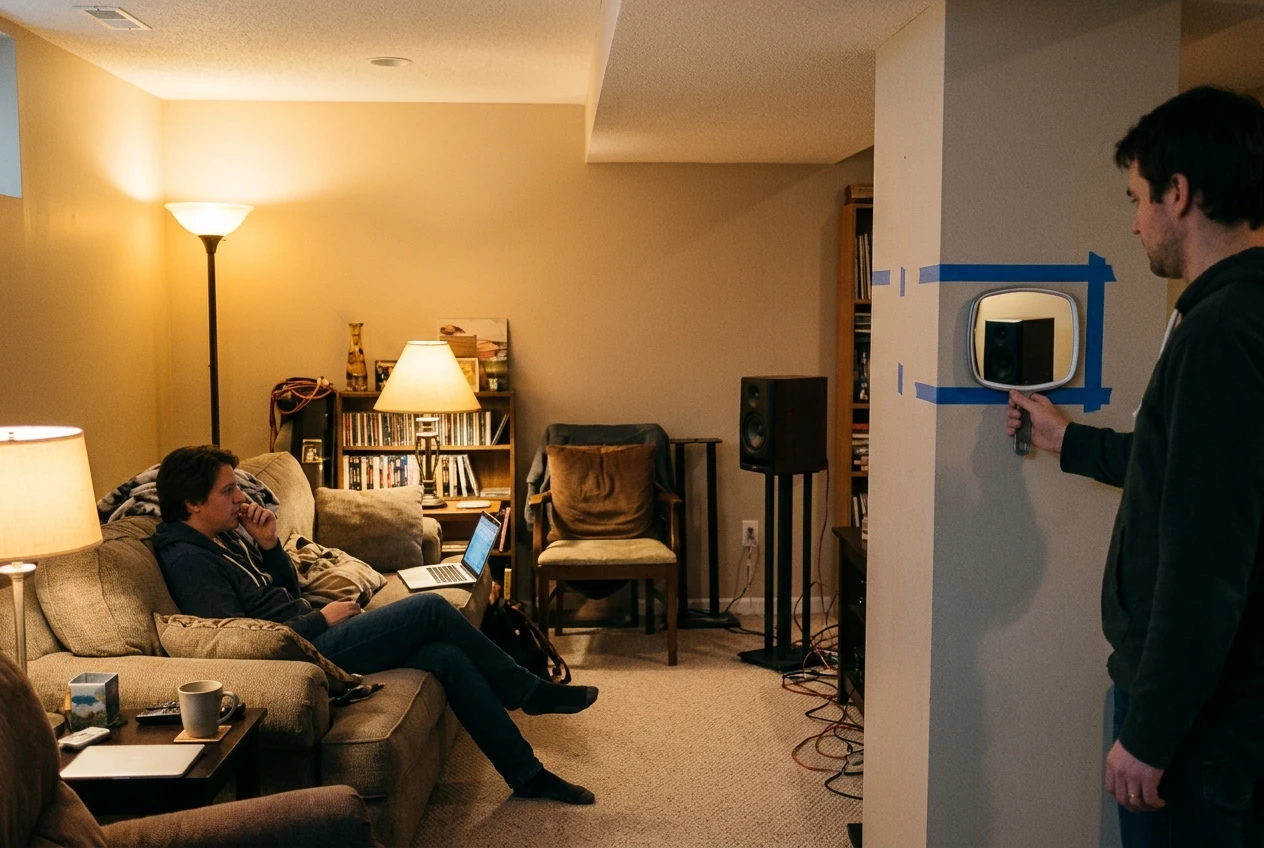
Finding them takes a helper and a hand mirror:
- Sit in your main viewing seat.
- Have your helper slide the mirror along the side wall, at ear height, from the front of the room toward you.
- When you can see a speaker in the mirror, mark that spot with painter’s tape. That is a first reflection point.
- Repeat for the other side wall, and do the same on the ceiling above your seat.
Put an absorbing panel at each marked spot. Thicker is better, and panels a few inches thick will outperform thin ones. A panel large enough to cover the taped area plus some margin gives the best result.
If your setup includes front, side, and rear speakers, the same idea applies to each of them. Start with the side walls beside your seating and the wall behind it, since those reflections usually cause the most smearing of dialogue and crowd noise.
Bass Traps and the Corner Problem in Garages and Basements
Bass gathers in corners, where two or three surfaces meet. A garage with concrete walls and a basement with a low ceiling make this worse, because the room is small and hard and there is no escape for low frequencies.
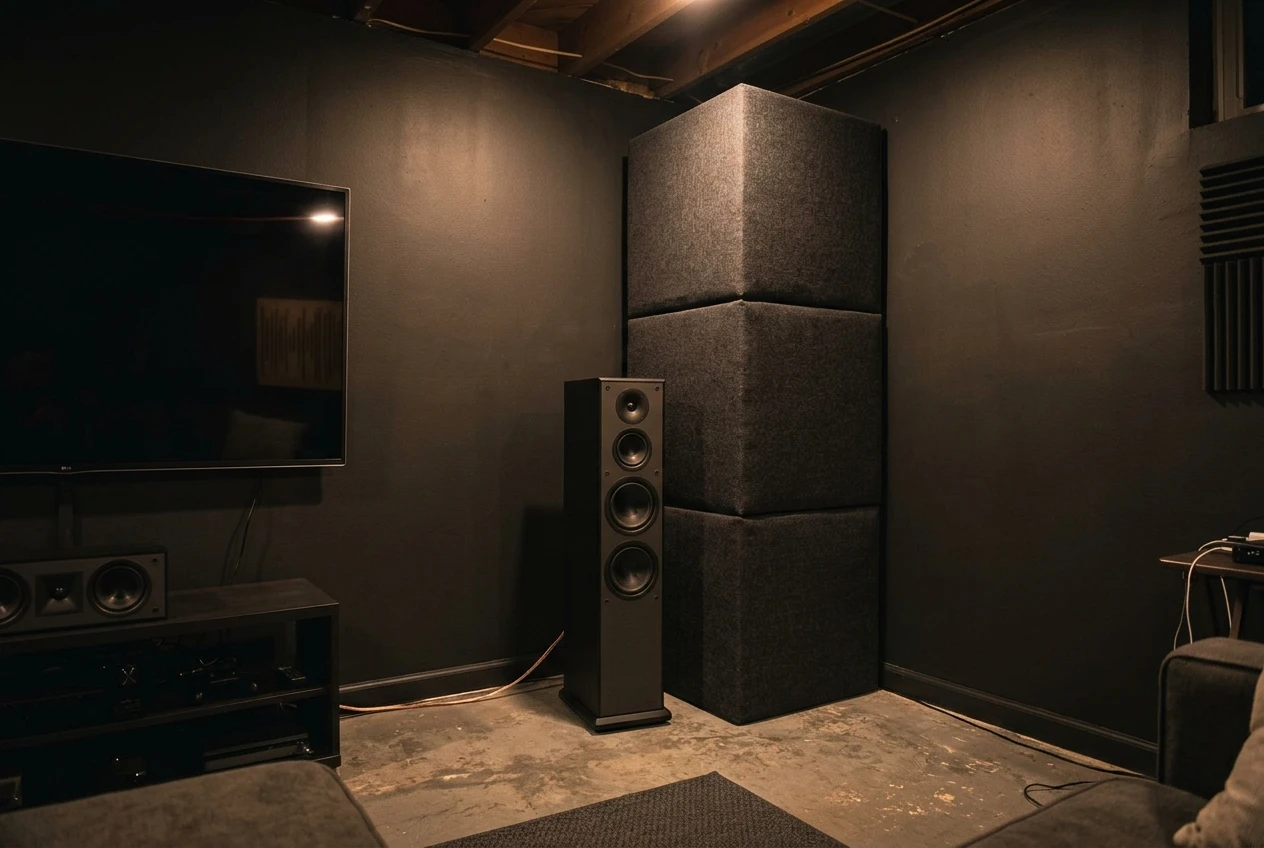
Bass traps go in the corners. The front two corners, behind or beside your speakers and screen, are the usual starting point. If the bass is still boomy, move on to the back corners and then to the ceiling corners where walls meet the ceiling.
A few practical notes:
- Go thick. Panels of four inches or more handle low frequencies much better than thin ones.
- Mount them across the corner. A trap can sit in a triangle across the corner, or stack up the corner from floor to ceiling.
- Check the fire rating. Whatever foam, fabric, or insulation you use, confirm that it is rated for fire safety, especially in a garage where tools and chemicals are stored.
- Mind the overhead door. A big metal garage door is a huge, thin reflector. A heavy curtain hung across it, or a treated panel on the inside, cuts a lot of ring.
Your bass walk from earlier is the test. If the swell in a corner is smaller and the difference between seats shrinks, the traps are working.
Treatment That Looks Like Decor
Here is where acoustic treatment stops looking like a studio. Every item below absorbs or scatters sound and also belongs in a sports room.
Fabric-wrapped panels. These are absorbing panels covered in fabric you choose. Team colors work well, and so does a neutral charcoal that disappears into the wall. Because they are sound-transparent, the fabric does not block the absorption underneath.
Custom printed art panels. Some companies print an image on the fabric stretched over an absorbing panel. That means a stadium shot, a team logo, a retro poster, or a giant action photo can be the thing that cuts your echo. Mounted at your first reflection points, they do both jobs at once. If you are planning wall art anyway, our guide to mancave wall decor ideas on a budget has ideas for what to hang around them.
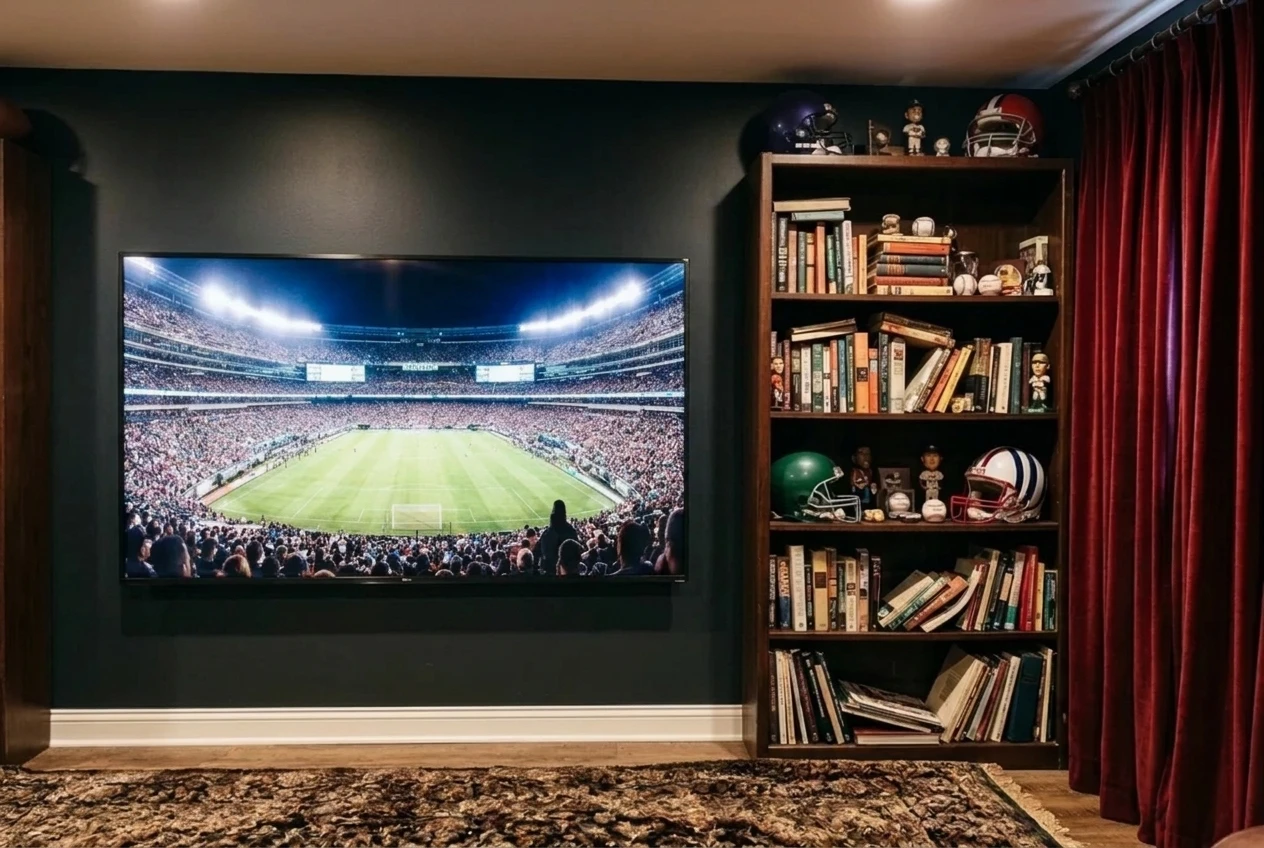
Area rugs. A thick rug with a dense pad underneath soaks up reflections from a hard floor, which matters most in garages and basements with concrete underfoot. Place it between your speakers and your seating, where the floor bounces sound toward you.
Heavy drapes. Thick, lined curtains absorb sound and also block light, which helps your picture. Hang them wider than the window and let them fold into pleats, since extra fabric absorbs more than a flat sheet. Drapes also work over a bare wall or a garage door, where they do the same job without a window behind them.
Bookshelves. A shelf filled unevenly with books, collectibles, helmets, and small display pieces breaks up sound and scatters it. It works as diffusion, and it gives you a place to show off what you collect. Our look at collectors’ showcase man cave displays has plenty of layouts worth borrowing.
Framed jerseys and memorabilia also help a little, but only a little. A single framed piece behind glass reflects sound, so treat those as decoration and let the panels do the acoustic work.
What to Leave Alone: Hard Surfaces You Can Keep
You do not have to soften everything. A room covered entirely in absorption sounds dull and lifeless, and voices can feel muffled. Some hard surfaces are worth keeping.
- The TV or screen. You cannot cover it, and you do not need to. Treat the walls around it instead.
- The bar top. Granite, wood, or stone looks great and does little harm when it is a small part of the room.
- Glass memorabilia cases. Keep them. Put absorbing panels nearby so the glass is not the only thing the sound meets.
- Wood paneling or a hard floor on part of the room. One hard surface is fine when other surfaces around it are soft.
The balance to aim for is simple. If the clap still rings, add more absorption. If voices sound muffled and the room feels stuffy, you have gone too far, and you can remove a panel or leave a wall bare. Listening to the same game broadcast after each change is the best way to find that point.
A Sensible Order to Treat the Room, From Cheapest Fix to Full Build
Work through the room in stages and test after each one. You may find you can stop before the final stage.
- Rug and drapes. These are the cheapest changes and the easiest to undo. Put a thick rug between the speakers and your seats, and hang heavy curtains over windows, bare walls, or the garage door. Rerun the clap test.
- Side wall and ceiling panels at the first reflection points. Use the mirror method, and mark the spots before you buy anything. Start with a pair of panels at the side reflection points and see what changes.
- Bass traps in the front corners. If your bass walk still shows boomy or uneven bass, add traps behind or beside your speakers, then move to the rear corners if needed.
- The back wall and ceiling. Sound that travels past you hits the back wall and returns. A panel or two there, and an absorbing panel overhead at the ceiling reflection point, cleans up what is left.
- Decor-based finishing. Swap in fabric-wrapped or custom-printed art panels where plain ones sit, add a stocked bookshelf for diffusion, and move your display pieces to spots where they will not cause new reflections.
By the end, the room should pass all three tests: a short, clean clap, clear commentary at normal volume, and even bass from seat to seat.
A treated room is ready for a better speaker setup. When you are ready to choose one, read our guide to the Best Surround Sound System For a Man Cave and pick speakers for a room that will let them sound their best.